
Ads get ignored. Forms get abandoned. Emails get deleted.
A quiz gives people a reason to do something before you ask them to buy, book, subscribe, or hand over their email.
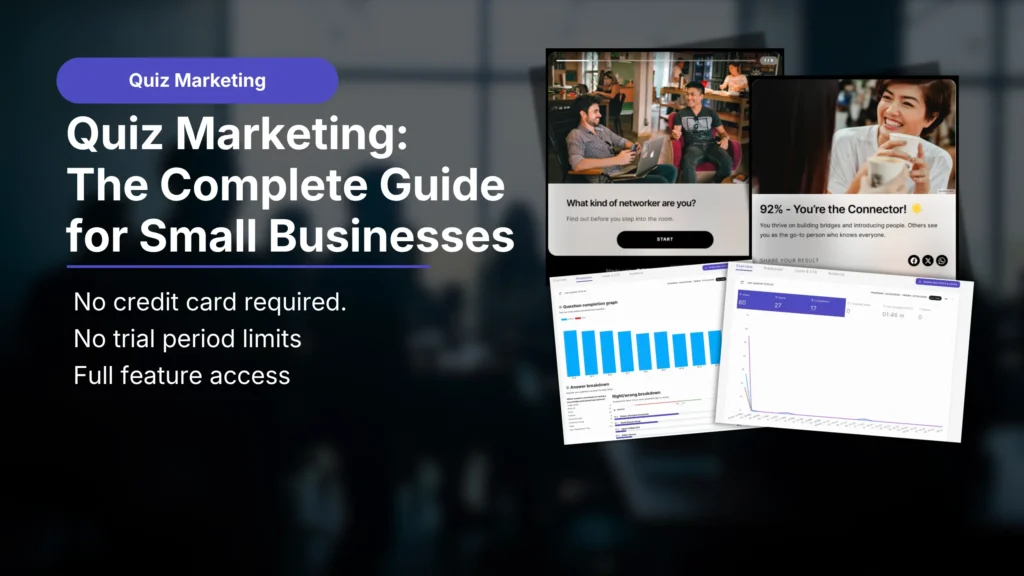
Quiz marketing is the use of interactive quizzes to attract attention, engage an audience, collect useful information, generate leads, recommend products, grow an email list, and drive action.
And you do not need a developer, an enterprise budget, or a six-week content project to make one work.
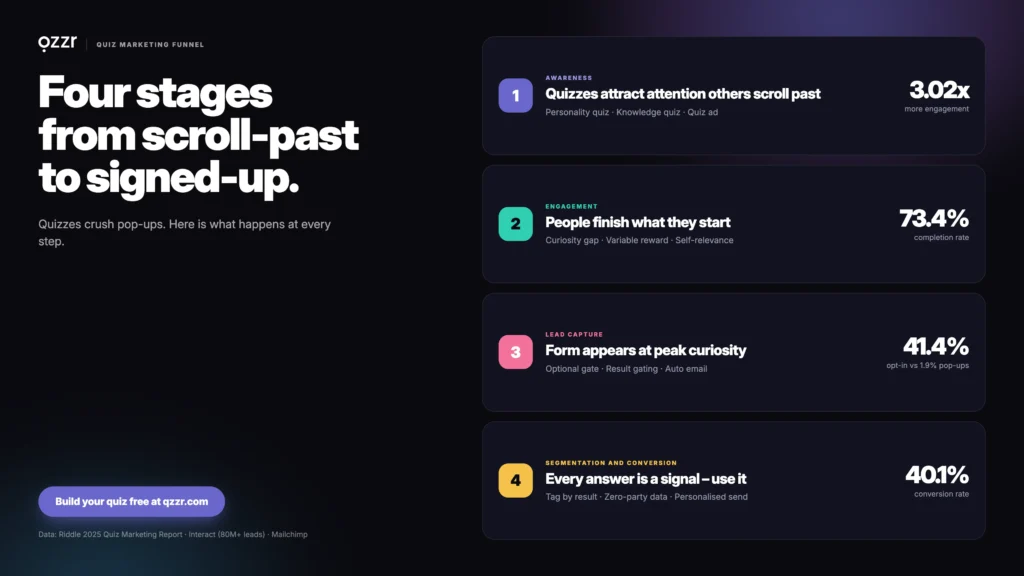
TL;DR: Quizzes turn marketing from a broadcast into a conversation. People answer questions, get something useful in return, and give you signals about what they actually want. Riddle’s 2025 Quiz Marketing Report analyzed 8.96 billion data points and 3.13 billion questions answered. It found that interactive content generated 3.02x more engagement than standard web pages, with quizzes and personality tests averaging 2 minutes 48 seconds per session and a 73.4% average completion rate.
What is quiz marketing?
Quiz marketing means using an interactive quiz as part of your marketing instead of treating a quiz as just a test.
Interactive quiz marketing is simply another way to describe this approach: using an interactive quiz to create a two-way marketing experience instead of relying only on static content, forms, or ads.
A traditional quiz asks:
How much do you know?
A marketing quiz can ask:
Which product is right for you?
Or:
How ready is your business for AI?
Or:
What type of marketer are you?
Or:
Which ticket package fits the way you attend games?
The person gets a result, recommendation, score, assessment, or another useful outcome. You get engagement, answers, and potentially a lead.
That changes the interaction.
Quiz marketing vs. traditional marketing
| Format | What you ask people to do | What they get |
|---|---|---|
| Ad | Click | An offer or information |
| Lead form | Submit information | An offer, resource, or follow-up |
| Blog post | Read | Information |
| Product page | Choose | A product |
| Quiz | Answer questions | A result, recommendation, score, or insight |
The important difference is what happens before the ask.
A cold form says:
Give me your email.
A quiz says:
Answer a few questions and I’ll tell you something useful.
That is a much easier conversation to start.
And this is the bigger idea behind quiz marketing: you are not just adding interactivity to your content. You are changing the decision context.
Instead of asking someone to decide whether your business is worth their time, you give them something worth interacting with first.
Why does quiz marketing work?
There is nothing magical about a quiz.
It works because it removes some of the friction built into traditional marketing.
1. Curiosity gives people a reason to start
“Download our guide” is familiar.
“What’s your marketing personality?” creates a question in someone’s head.
“Which product is right for you?” promises an answer.
“How ready is your business for AI transformation?” gives someone a reason to find out.
The quiz creates an information gap. People want to close it.
2. Self-relevance keeps people going
People are naturally interested in information about themselves.
That is why personality quizzes work so well. The user is not just consuming your content. They are part of it.
The same principle works for assessments and product finders.
Instead of:
Here are our 30 products.
You ask:
What are you looking for?
Then you narrow the choices.
3. Small interactions feel easier than big commitments
Answering one question is easy.
Then another.
Then another.
Suddenly someone has completed a seven-question quiz without feeling like they just filled out a form.
That is the advantage of breaking a large commitment into small interactions.
4. Results give people a reason to act
A quiz should lead somewhere.
The result might be:
- A product recommendation
- A personalized assessment
- A score
- A discount
- A consultation
- A relevant article
- An email sequence
- A course recommendation
The result creates a natural next step.
5. You learn what people actually want
A page view tells you someone visited.
A click tells you someone clicked.
A quiz answer can tell you why they are there.
Someone might tell you:
- Their budget
- Their experience level
- Their biggest problem
- Their priorities
- Their preferences
- What product they need
- What type of content they want
That is useful marketing data because the person gave it to you directly.
Stop guessing. Start asking.
Does quiz marketing actually work?
The Riddle 2025 Quiz Marketing Report is based on 8.96 billion data points from interactive content, including 3.13 billion individual questions answered.
The report found:
| Metric | Result |
|---|---|
| Questions answered | 3.13 billion |
| Total data points analyzed | 8.96 billion |
| Engagement vs. standard web pages | 3.02x |
| Average quiz/personality session | 2 min 48 sec |
| Average completion rate across formats | 73.4% |
| Total time spent with Riddle content | 32.8 million hours |
| Quiz shares happening on WhatsApp | 74% |
Source: Riddle’s 2025 Quiz Marketing Report
The lead-generation numbers are interesting too.
In a Riddle Lab experiment comparing quiz-based advertising with standard pop-up advertising:
| Metric | Traditional pop-up ad | Riddle quiz ad |
|---|---|---|
| Average CPC | €0.05 | €0.04 |
| CTR | 13.48% | 22.97% |
| Total leads | 96 | 115 |
| Cost per lead | €1.11 | €0.71 |
The quiz-based approach reduced cost per lead by 37% in that experiment.
That does not mean every quiz will magically reduce your CPL by 37%. It means the format can change the economics of the interaction.
There is another useful benchmark from the report: quiz sessions averaged 2 minutes 48 seconds, compared with 54 seconds for a typical article or news page cited in the report.
More attention is not the goal by itself. But when someone spends more time answering relevant questions, you have more opportunity to understand them and move them toward an action.
The point is not to chase a benchmark
Don’t build a quiz because someone else got a 73.4% completion rate.
Build one because you have a marketing problem that a quiz can solve.
What ROI can you expect from quiz marketing?
There is no universal quiz marketing ROI number. Your results depend on your traffic, offer, audience, quiz experience, and what happens after someone completes it.
But the available benchmarks show why the format is worth testing.
In a Riddle Lab experiment comparing quiz-based advertising with standard pop-up advertising, the quiz approach produced a 37% lower cost per lead, falling from €1.11 to €0.71. CTR was also higher, at 22.97% versus 13.48%, while total leads increased from 96 to 115.
The broader Riddle 2025 Quiz Marketing Report found that interactive content generated 3.02x more engagement than standard web pages.
These are not promises of what your next quiz will generate. They are signals that changing the interaction can improve both engagement and acquisition economics.
Need more leads? Use a lead generation quiz.
Too many products? Build a product finder.
Sending the same email to everyone? Segment your list with a quiz.
Need more organic engagement? Build content people want to finish and share.
The 5 ways small businesses use quiz marketing
You do not need five different campaigns.
Start with one problem and pick the quiz use case that solves it.
1. Generate leads with quizzes
The classic lead form asks for an email before giving anything back.
A quiz flips the order.
Someone answers five to eight questions. They reach the point where they want their result. Then the lead form appears.
The email becomes part of the value exchange instead of the price of admission.
For example, a coach could build:
How Ready Are You to Scale Your Business?
The quiz asks about revenue, team size, marketing, sales, and operational challenges.
At the end, the person gets a readiness score and recommended next steps.
Then the coach can ask for an email to send the detailed assessment.
Go deeper: Quiz Lead Generation: How to Capture More Leads Without the Hard Sell
2. Segment and personalize your audience
Most email lists eventually become one giant bucket.
Everyone gets the same newsletter.
Everyone gets the same offer.
Everyone gets the same welcome sequence.
That is convenient for the marketer. It is not necessarily useful for the subscriber.
A quiz gives you another option.
Ask:
What’s your biggest marketing challenge?
The answers can become segments.
- Need more leads
- Need better conversion
- Need better content
- Need better customer retention
Now your follow-up can match the answer.
Every answer is a declared data point. The customer is telling you something instead of you trying to infer it from clicks and page views.
Go deeper: Quiz Segmentation: How to Use Quizzes to Segment Your Email List
3. Recommend the right product or service
Choice is useful until there is too much of it.
A store with 30 products might think it is giving customers more options.
The customer might think:
Which one am I supposed to buy?
A product recommendation quiz changes the question.
Instead of asking customers to compare your catalogue, ask them about themselves.
For example:
Find Your Perfect Running Shoe
Ask about:
- Running frequency
- Typical distance
- Terrain
- Comfort preferences
- Budget
Then recommend the product that best matches their answers.
The same idea works for:
- Skincare
- Coffee
- Supplements
- Clothing
- SaaS plans
- Coaching packages
- Consulting services
- Courses
One example from Qzzr’s product recommendation guide uses four ticket packages. The quiz asks about attendance habits, seating preferences, perks, budget, and commitment level, then recommends a package such as the Ultimate Fan Experience, Balanced Bundle, Budget-Friendly Option, or Flexi-Ticket.
The customer gets advice instead of another sales pitch.
Go deeper: How to Create a Product Recommendation Quiz
4. Create content people actually want to share
Not every quiz needs to generate a lead.
Sometimes the goal is attention.
Personality quizzes are naturally shareable because people share the result, not the marketing campaign.
I got Ravenclaw.
Apparently I’m a 90s kid through and through.
I’m an introvert with extrovert tendencies.
The quiz becomes a way for someone to say something about themselves.
Knowledge quizzes work differently.
How well do you know SEO in 2026?
Can you spot a fake email?
How much do you know about European football?
These can be saved, retried, linked to, and shared because they have utility and benchmark value.
A useful rule:
Personality quizzes spread through identity. Knowledge quizzes spread through utility.
Qzzr’s content marketing guide goes deeper into the difference and how to design quizzes for sharing and organic reach.
Go deeper: Quiz Content Marketing: How to Create Viral Quizzes
5. Grow and segment your email list
Quiz email marketing combines two things that normally require separate campaigns:
- Get the email.
- Learn something useful about the person.
For example, a sports club could build a ticket package quiz.
Someone answers questions about:
- Attendance habits
- Seating preferences
- Budget
- Perks
- Commitment level
The quiz recommends a ticket package.
The lead form asks for an email before the result.
Now the club has a subscriber and a useful preference attached to that subscriber.
The person interested in premium season packages does not need the same follow-up as someone interested in pay-per-match tickets.
That is a much better starting point for email marketing.
Go deeper: Quiz Email Marketing: Grow Your List
Quiz marketing examples by business type
You do not need a complicated marketing funnel.
You need a useful question for every use case.
E-commerce
Try:
- Which product is right for you?
- Find your perfect skincare routine
- Which running shoe should you buy?
- Find the perfect gift
- Which coffee is your match?
The quiz narrows the choice and sends the customer toward a product.
Coaches and consultants
Try:
- How ready are you to scale?
- What’s holding your business back?
- Which marketing strategy fits your business?
- How mature is your sales process?
- What type of support do you need?
The result can become both a lead magnet and a qualification tool.
Content creators and publishers
Try:
- How much do you know about [topic]?
- Which [category] are you?
- Can you identify these [things]?
- Test your knowledge of [subject]
- Predict what happens next
The goal here is often engagement, repeat visits, sharing, and newsletter growth.
Service businesses
Try:
- Which service do you need?
- What type of plan fits you?
- How much support do you need?
- What is your biggest challenge?
- Get your personalized recommendation
The quiz helps visitors figure out what to do next.
Educators and training businesses
Try:
- Test your knowledge
- What’s your skill level?
- Which course should you take?
- Take a pre-course assessment
- See where your knowledge gaps are
A quiz can make the assessment part of the experience rather than an obstacle before it.
How to build a quiz marketing funnel
You do not need a complicated funnel diagram with 14 boxes.
Start here.
Step 1: Pick one goal
Choose one:
- Generate leads
- Recommend products
- Segment your audience
- Grow your email list
- Increase engagement
- Drive a sale
- Qualify prospects
Do not try to make one seven-question quiz do everything.
Step 2: Choose the format
Your goal should determine the format.
Selling products? Product recommendation.
Want leads? Assessment or lead generation quiz.
Want shares? Personality quiz.
Want search traffic? Knowledge quiz.
Want predictions? Predictor.
Step 3: Write questions that feel like a conversation
Bad:
Select your annual expenditure category.
Better:
What’s your typical monthly marketing budget?
Better still:
How much are you comfortable spending on marketing each month?
The questions should feel like they belong to the experience.
Step 4: Give value before asking for the lead
This is one of the biggest advantages of quiz lead generation.
Do not open with:
Enter your email.
Give people a reason to care first.
Let them answer the questions. Then ask for the email when they are about to receive something they want.
Step 5: Capture only what you need
If you only need an email, ask for an email.
If you need a name to personalize the result, ask for the name too.
Do not turn a seven-question quiz into a 14-field registration form.
Step 6: Connect the result to an action
The result should lead somewhere.
For example:
Result: Your business is ready for AI experimentation.
Next step: Download the AI readiness checklist.
Or:
Result: You’re a Flexible Fan.
Next step: See the Flexi-Ticket package.
Or:
Result: Your marketing priority is lead generation.
Next step: Book a strategy call.
Step 7: Distribute the quiz
A quiz sitting on your website is not a marketing strategy.
Put it where people already are:
- Website
- Blog posts
- Landing pages
- Paid ads
- QR codes
- Events
Step 8: Measure what happens after the quiz
Track:
- Quiz starts
- Completion rate
- Question drop-off
- Lead conversion
- Result distribution
- CTA clicks
- Email engagement
- Sales or bookings
A high completion rate is nice.
A quiz that produces business results is better.
Which quiz format should you use?
There are dozens of ways to build interactive content. Start with the format that matches your goal.
| Quiz format | Best for | Example |
|---|---|---|
| Personality quiz | Engagement, sharing, brand awareness | What Type of Marketer Are You? |
| Knowledge quiz | Education, SEO, repeat traffic | How Well Do You Know SEO? |
| Assessment | Lead generation, qualification | How Ready Is Your Business for AI? |
| Product recommendation | E-commerce, sales | Which Running Shoe Is Right for You? |
| Predictor | Engagement, events, sports | Who Will Win the Match? |
| Minigame | Engagement and retention | Crossword, Sudoku, Typerush |
The rule of thumb
Do not choose the format because it looks fun.
Choose it based on what you want the person to do next.
How to create a quiz people actually finish
Getting someone to start is only half the job.
Keep it short
Riddle’s 2025 report identifies 6 to 10 questions as a useful engagement sweet spot, with session duration nearly doubling once a quiz exceeds five items.
That does not mean every quiz needs exactly eight questions.
It means you should have a good reason for every question you add.
Make every question earn its place
If a question does not change the result, recommendation, segmentation, or experience, ask yourself why it is there.
You probably do not need it.
Show progress
People should know whether they are on question 2 of 8 or question 2 of 80.
There is a psychological difference.
Make the result worth getting
The result should not be:
Thanks for taking our quiz! Contact us to learn more.
That is not a result.
Give them something useful.
A recommendation.
A score.
An assessment.
A comparison.
A next step.
Make it mobile-first
If your quiz is being shared on social media or email, assume people will take it on their phone.
Large buttons. Short questions. Easy-to-read results.
No tiny desktop-only interfaces.
Make the result shareable
Especially for personality and knowledge quizzes.
Give people a reason to say:
I got this. What did you get?
According to Riddle’s 2025 report, 74% of quiz shares occurred on WhatsApp. The share button matters, but the result people want to share matters more.
Common quiz marketing mistakes
1. Turning the quiz into a disguised lead form
If the first thing you ask for is an email, you have not really changed the interaction.
2. Asking for an email too early
Give people a reason to want the result first.
3. Making the quiz too long
Nobody signed up for an exam.
4. Asking questions that do not matter
Every question should have a job.
5. Giving everyone the same result
If the answers do not change anything, why ask the questions?
6. Making the result a sales pitch
A useful result builds trust.
A sales pitch disguised as a result destroys it.
7. Forgetting the follow-up
Someone completes your quiz and gives you their email.
Then nothing happens.
Do not waste the lead.
Use the answers to send something relevant.
8. Measuring the wrong thing
Do not celebrate 10,000 completions if nobody clicks the CTA, joins the list, books a call, or buys.
Measure the outcome you actually care about.
What to look for in a quiz marketing tool
If you are comparing the best quiz marketing platform for a small business, do not start with the biggest feature list. Start with what you actually need to launch and improve a quiz.
You do not need an enterprise interactive content platform.
You need a tool that lets you build and publish a useful experience without creating another technical project.
Look for:
No-code building
You should be able to create, edit, and publish the quiz yourself.
Multiple formats
Personality, knowledge, assessment, product recommendation, predictor, polls, and other interactive formats give you more options as your strategy grows.
Lead capture
You should be able to collect leads inside the experience rather than stitching together multiple tools.
Results logic
Different answers should be able to produce different results.
Integrations
If you already use an email platform or CRM, your quiz should fit into that workflow.
Embedding
You should be able to put the quiz on your website, landing page, blog, or other channel.
Analytics
You need to know where people drop off and what they do after completing the quiz.
Mobile support
Because a quiz that looks great on your laptop and terrible on a phone is not ready to publish.
Privacy and accessibility
Your interactive content should be usable and compliant without requiring you to build everything yourself.
Pricing that makes sense
If you are a small business getting 500 quiz completions a month, you probably do not need a $500-per-month enterprise platform.
Why Qzzr for quiz marketing
Qzzr is built for the team that wants to make the quiz, publish it, and move on with their day.
No developer required.
No giant implementation project.
No need to buy an enterprise interactive-content platform just to build a seven-question quiz.
30+ interactive formats
Build personality quizzes, assessments, polls, knowledge quizzes, predictors, minigames, crosswords, Sudoku, and more.
AI-powered quiz creation
Start with a topic or paste in a URL and use AI to get the quiz started.
Lead generation built in
Collect leads as part of the quiz experience instead of bolting a separate form onto it.
Full features on the free plan
Qzzr lets you build and publish without locking the important features behind an enterprise-style plan.
Built for small teams
You can create, publish, embed, and manage your quizzes without a developer.
Start free
Qzzr is free for up to 300 completions per month. When you need more, plans start at $9/month for 1,000 completions.
Quiz Marketing FAQ
What is quiz marketing?
Quiz marketing is using interactive quizzes as a marketing tool to attract attention, engage an audience, collect information, generate leads, personalize experiences, recommend products, or drive conversions.
Does quiz marketing work for small businesses?
Yes. Quizzes can be useful for small businesses because they do not require a large development team or complex technology. A coach can use an assessment to generate qualified leads. An e-commerce store can use a product finder. A consultant can use a readiness quiz to qualify prospects.
How do I use a quiz to generate leads?
Create a short quiz that provides a useful result. Place a lead form before the result, when the user is already interested in seeing what they got. Ask only for the information you need, then use the quiz answers to personalize your follow-up.
What type of quiz is best for marketing?
It depends on your goal. Use a personality quiz for sharing and awareness, a knowledge quiz for engagement and educational content, an assessment for lead generation, a product recommendation quiz for sales, and a predictor for events and engagement.
How do I create a quiz marketing funnel?
Start with one goal. Choose the right quiz format. Write useful questions. Build a valuable result. Add lead capture if you need it. Connect the result to a relevant CTA or follow-up sequence. Then distribute the quiz across your website, email, social channels, or ads and measure the results.
How can quizzes help with audience segmentation?
Quiz answers are information that people voluntarily provide about themselves. You can use those answers to group leads by needs, preferences, experience, budget, goals, or other criteria and then send more relevant follow-up messages.
Can I use quizzes to recommend products?
Yes. Product recommendation quizzes ask about a customer’s needs and preferences, then match their answers to the most relevant product or service. They are especially useful when customers have too many choices and need help narrowing them down.
Can quizzes grow an email list?
Yes. A quiz can give people a reason to subscribe because they want the result, recommendation, or assessment. Qzzr’s quiz email marketing research cites a 41.4% quiz opt-in rate compared with 1.9% for pop-ups in the referenced benchmark.
How much does quiz marketing cost?
The marketing strategy itself does not have to be expensive. The cost depends on the quiz platform, traffic, distribution, and integrations you use. Qzzr has a free plan for up to 300 completions per month, with paid plans starting at $9/month for 1,000 completions.
What is the best quiz marketing tool?
The best tool depends on what you need. For a small business or lean marketing team, look for a no-code builder, multiple formats, lead capture, results logic, analytics, integrations, mobile support, and pricing that matches your actual usage.
Explore quiz marketing by use case
Want to go deeper? Start with the problem you are trying to solve.
Quiz Lead Generation
Capture leads without the hard sell. Learn how to warm up a visitor with a quiz before asking for their email.
Quiz Segmentation and Personalization
Use quiz answers as zero-party data and send different messages to different segments.
Product Recommendation Quizzes
Help customers find the right product instead of making them compare a catalogue of options.
Quiz Content Marketing
Create quizzes that earn attention, sharing, saves, and organic traffic.
Quiz Email Marketing
Grow your email list and use quiz answers to make your follow-up more relevant.
Final takeaway
You do not need more content just for the sake of having more content.
You need content that gives people a reason to interact.
That is what makes quiz marketing different.
A blog post asks someone to read.
A form asks someone to give.
An ad asks someone to click.
A quiz asks someone a question and gives something back.
Ask a better question. Get a better conversation.