
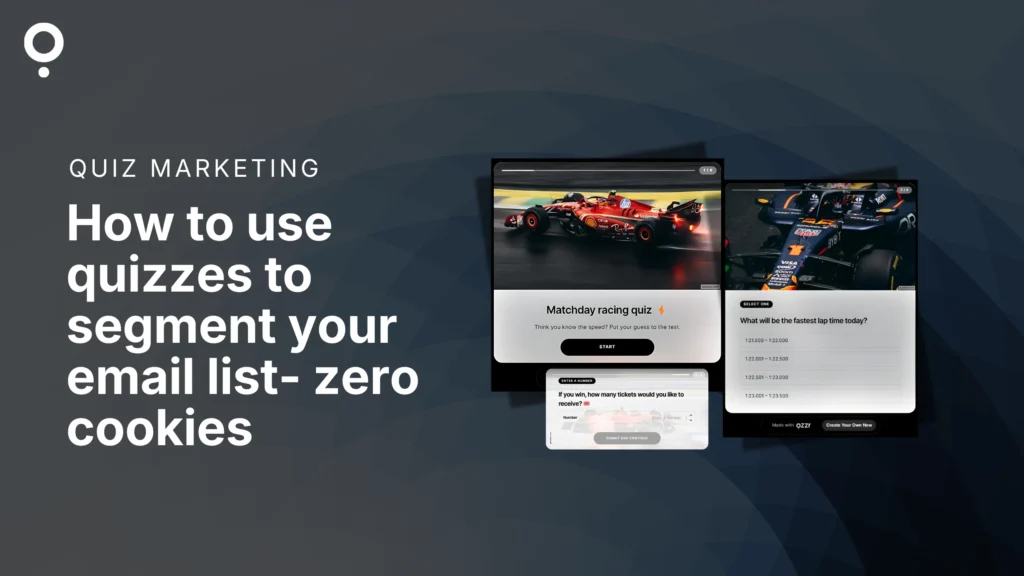
TL;DR: Quiz segmentation uses quiz answers to sort leads into groups automatically, before a single email is sent. Every answer is zero-party data – information the customer chose to tell you, not data you guessed from a click. No tracking pixel needed. Build it free with Qzzr and send the right message to the right person, every time.
What is quiz segmentation?
Quiz segmentation is the practice of using quiz answers to sort leads into groups automatically – before a single email is sent, before a single sales conversation happens.
Most email lists are one big pile. Same welcome email. Same offer. Same everything, blasted at everyone. It doesn’t matter who they are or what they actually want.
That’s the problem. Quiz segmentation is the fix.
Every question in your quiz is a data point. Are they a beginner or three years in? Price-sensitive or quality-first? What’s the actual thing stopping them right now? By the time they hit the lead form, you already know more about them than most businesses learn after months of cold emails.
That data gets attached to their email address. From there, your email tool does the rest: different sequences, different offers, different tone – all based on what they told you.
No tracking. No pixel. No cookie. Just answers, given willingly, because they wanted their result. And with a free quiz maker like Qzzr, the whole setup takes less than an hour.
Why it works: declared data beats behavioral data
There are two ways to know something about a customer. Observe their behavior and guess. Or ask them and find out.
Behavioral data – clicks, page views, time on site – tells you what someone did. Not why they did it. A person who clicked on a running shoe ad might be shopping for themselves, buying a gift, or researching for a school project. The click doesn’t tell you which.
A quiz tells you directly. “What’s your biggest fitness goal right now?” gets a declared answer. Real, specific, chosen by the person giving it. That’s what makes zero-party data different from behavioral data: the customer chose to tell you, on purpose, in their own words.
And it matters more now than it ever did. Around a third of web users globally block tracking with ad blockers. Behavioral data is getting noisier and less reliable. Declared data is free, accurate, and gets better every time someone takes your quiz.
Stop guessing. Start asking.
The numbers: what the data says
Figures from the Riddle 2025 Quiz Marketing Report, based on 3.13 billion quiz questions answered.
| Metric | Result |
|---|---|
| Quiz opt-in rate vs. pop-ups | 41.4% vs. 1.9% |
| Average quiz completion rate | 73.4% |
| Engagement vs. standard web pages | 3.02x more |
| Average session duration (quiz vs. article) | 2 min 48 sec vs. 54 sec |
Here’s the one that matters most for segmentation: 73.4% of people who start a quiz finish it. Nearly three out of four visitors hand over a complete set of answers, not just an email address. That’s a segmented profile, not just a contact.
A standard sign-up form gets you a name and an email. That’s it. A quiz gets you the same contact details plus everything you need to actually use them.
Zero-party data, explained simply
Zero-party data is anything a customer tells you on purpose. Not what they clicked. Not what a cookie inferred. What they actually said about themselves.
There’s a simple hierarchy:
Third-party data – bought from someone else, about people who have no idea you have it. Increasingly unreliable, increasingly restricted.
First-party data – what you collect on your own site: page views, purchases, time on page. Useful, but still behavioral. Still a guess at intent.
Zero-party data – the customer telling you directly. “I’m a beginner.” “I prefer bold colours.” “I need this for a wedding next month.” No inference needed.
Quizzes are the easiest way to collect zero-party data at scale. A preference centre sits behind a login nobody visits. A survey feels like homework. A free quiz maker feels like a quick, fun way to find something out. That’s the trade that makes people actually answer honestly.
Quiz segmentation in practice: three examples
Example 1: skincare brand
Quiz: “What does your skin actually need right now?”
Segments: Oily / dry / sensitive / combination, plus routine preference (minimal vs. multi-step).
What happens next: Each segment gets different product recommendations and a different email sequence. The person who said “sensitive skin, minimal routine” never sees an email about a 10-step exfoliating regimen. The segmentation isn’t a nice extra. It’s the whole point.
Example 2: B2B consultant
Quiz: “Is your team ready to scale?”
Segments: Early-stage / growth-stage / scaling-fast, based on team size, process maturity, and the biggest bottleneck.
What happens next: Early-stage leads get educational content and low-commitment resources. Scaling-fast leads get a direct call-to-action to book a strategy call. Same quiz. Two completely different follow-up paths. Based entirely on what the lead said about themselves.
Example 3: online course creator
Quiz: “What’s stopping you from hitting your goals?”
Segments: Time-poor / unmotivated/lacking structure / lacking knowledge.
What happens next: Each segment gets a tailored sequence addressing their specific blocker, with the course pitched as the solution to exactly that problem. Not a generic “improve your life” pitch. The message matches the actual reason someone hasn’t acted yet. That’s why quiz leads convert.
Try it yourself
Here’s a live product recommendation quiz – see exactly how quiz segmentation works in action.
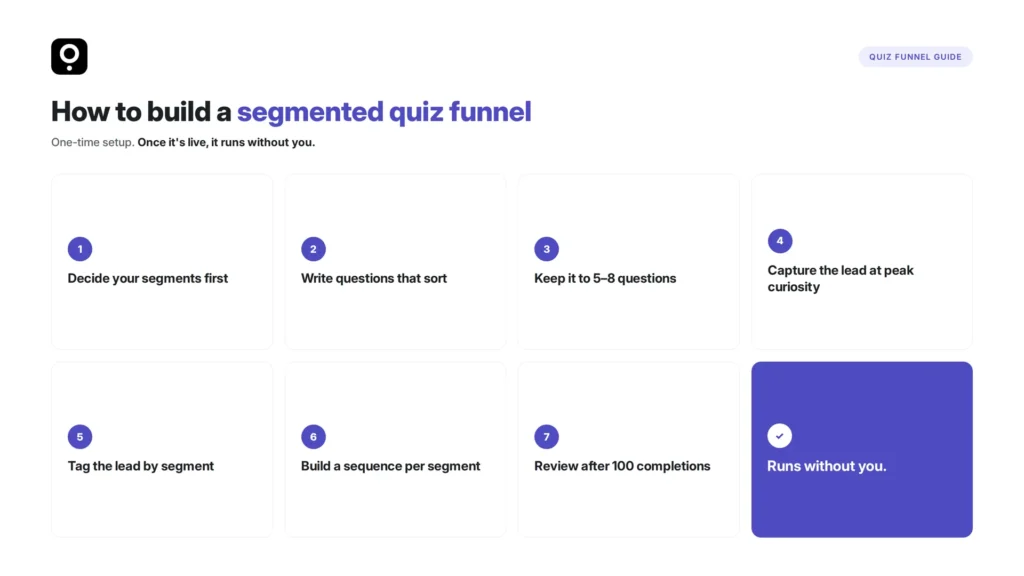
How to build a segmented quiz funnel: step by step
One-time setup. Once it’s live, it runs without you.
Step 1: Decide your segments before you write a single question.
Don’t build the quiz and hope segments fall out of it. Decide the groups first: beginner vs. advanced, price-sensitive vs. quality-first, urgent vs. exploring. Write backward from there.
Step 2: Write questions that map directly to your segments.
Every question should sort people into one of your groups. If a question doesn’t help you segment, cut it. This isn’t a personality quiz for fun. It’s a sorting mechanism wearing a personality quiz’s clothes.
Step 3: Keep it to 5 to 8 questions.
More questions, more drop-off. Five sharp questions that cleanly sort your segments beat twelve vague ones every time.
Step 4: Capture the lead at peak curiosity.
Right before the result. Not before question one (no trust built yet) and not after the result (they already got what they came for). The moment before the result is peak intent. That’s where 41% opt-in rates happen.
Step 5: Tag the lead with their segment, not just their email.
This is the step most people skip. Qzzr sends quiz answers alongside the email address so your email tool can tag the lead automatically. Skip this step and you’ve built a great quiz and a useless list.
Step 6: Build a sequence for each segment.
Two or three result-based sequences, each speaking directly to that segment’s situation, will outperform one generic blast to your whole list. Every time.
Step 7: Review after 100 completions.
Check how your segments split. If 90% of people land in one group, your questions might be too predictable, or your audience is more uniform than you thought. Either way, that’s useful. Adjust if needed.
Ready to try it? Build your first segmented quiz funnel in Qzzr free – no card required, no locked features.
What good segmentation questions look like
A weak segmentation question asks for facts you could get from a form: age, job title, company size. That’s data entry, not segmentation.
A strong segmentation question asks about intent, preference, or situation. “What’s your biggest challenge right now?” “What matters most to you when choosing X?” “Where are you in this process?” These reveal how someone thinks, not just who they are on paper.
Four patterns that consistently produce clean segments:
Situation-based: “Which of these sounds most like you right now?”
Priority-based: “What matters most: speed, price, or quality?”
Obstacle-based: “What’s the biggest thing standing in your way?”
Stage-based: “Where are you: just starting, partway through, or ready to commit?”
Each one sorts people into a small number of clean, actionable groups. No interrogation. No friction. Just a conversation.
Common mistakes to avoid
Building the quiz before deciding the segments. You’ll end up with interesting data and no clean way to act on it. Segments first. Always.
Too many segments. Three to five groups is workable for a small team. Twelve micro-segments from one quiz is complexity you can’t action without a dedicated data team. Start broad.
Collecting data and never using it. Most common failure mode. A detailed quiz with no follow-up sequence is wasted effort. If someone answers honestly and gets the same generic welcome email as everyone else, they notice. They won’t share data with you again.
Letting behavioral data override declared data. Someone told you they’re a beginner. Don’t let a stray click reclassify them as advanced. Declared answers anchor the segment. Behavioral signals add context. They don’t overrule what the person actually said.
Treating it as a one-time pull. Segments aren’t static. Run the quiz periodically or let people retake it. Circumstances change. Your data should too.
How Qzzr handles quiz segmentation
No API needed. No data team. No third-party tracking tool to bolt on.
Qzzr’s free quiz maker captures every quiz answer alongside the lead’s email and pushes it straight into your email tool. Mailchimp, ActiveCampaign, Brevo, and AWeber all connect natively. Segments are ready to use the moment the quiz goes live.
Free plan: 300 completions, full features, no credit card. After that, $9 a month for 1,000 completions. Need more? Add 1,000 for $5.
That’s it. No fluff. No annoying upsells.
You don’t need an enterprise martech stack to segment your audience. You need one well-built quiz and an email tool that can act on what it tells you.
Ready to build a list that already knows who’s who? Create your segmented quiz free on Qzzr – no credit card, no locked features, 300 completions to start.
You asked. We answered.
What is quiz segmentation?
It’s the practice of using quiz answers to automatically sort leads into groups, so each group gets different, relevant follow-up content instead of one generic message to everyone.
What’s the difference between quiz segmentation and quiz lead generation?
Lead generation captures the email. Segmentation is what you do with the answers attached to it. Most quizzes do both at once: capture the lead and sort them into a group, in a single step.
What is zero-party data?
Information a customer chooses to tell you directly – preferences, intentions, self-described needs. Different from first-party data (what you observe) and third-party data (bought from someone else). Quizzes are one of the most effective ways to collect it at scale.
How many segments should I create from one quiz?
Three to five. More than that becomes hard to act on without a dedicated team. Start broad and split further only if the data justifies it.
Can I segment my email list without a CRM?
Yes. Qzzr connects directly to Mailchimp, ActiveCampaign, Brevo, and AWeber – all of which support tagging and segmented sequences without a separate CRM.
Is quiz segmentation GDPR compliant?
Yes. Because the data is given voluntarily and with clear context, it fits cleanly within GDPR’s consent requirements. Qzzr stores data on secure servers. You control consent language and retention settings.
Related reading
- Quiz Lead Generation: How to Capture More Leads Without the Hard Sell
- Best Quiz Tool for WordPress Content Marketing (Free, 2026)
Statistics sourced from the Riddle 2025 Quiz Marketing Report, based on 3.13 billion quiz questions answered.